
ServiceNow Source-to-Pay
Successfully implementing source-to-pay – with servistio
Requests for goods sent by email, approvals given verbally, supplier data spread across three systems, and invoices that sit unprocessed for weeks whilst issues are clarified. In many companies, the procurement and accounts payable departments operate outside the ERP system – and this is precisely where the process loses time, transparency and potential for cost savings. servistio helps companies set up the entire procurement process in ServiceNow in such a way that it can be managed end-to-end: from requirements capture through sourcing, supplier onboarding and contracts right through to invoice processing. The ERP system remains the transactional backbone. ServiceNow orchestrates everything before, during and after that.

Official Partner of

From requirement to payment
What is ServiceNow Source-to-Pay (S2P)?
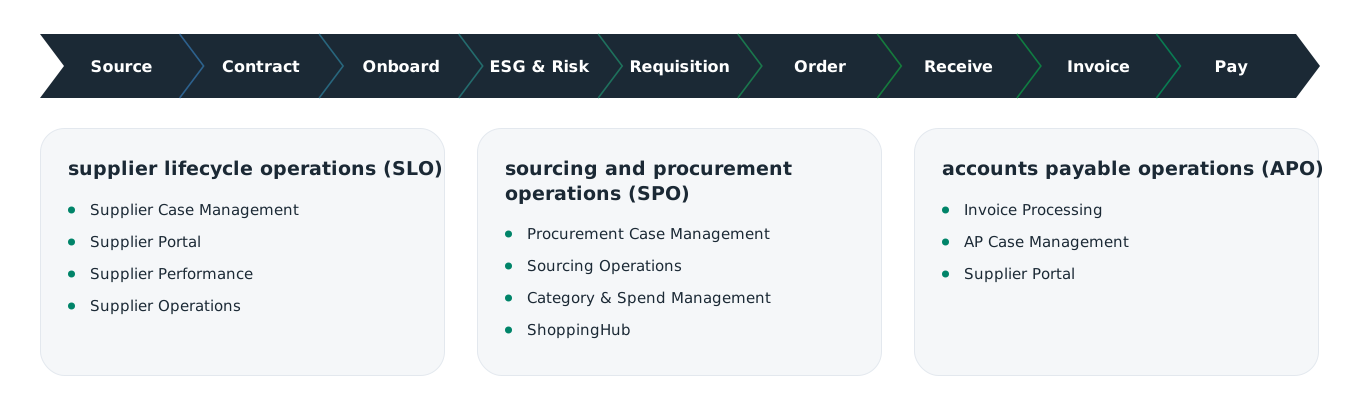
Source-to-Pay describes the entire procurement process: from identifying requirements and selecting suppliers, through to contracts and purchase orders, right through to invoice verification and payment. Traditional ERP systems are designed to process high volumes of transactions such as purchase orders. ServiceNow Source-to-Pay Operations supports the work that takes place before and between these transactions – planning, sourcing, onboarding and day-to-day management. It is not a replacement for an ERP system, but rather a process and service layer on the ServiceNow AI Platform.
These are the objectives companies aim to achieve with ServiceNow S2P
What components make up the solution
Sourcing and Procurement Operations
Central point of contact for all procurement enquiries, guided requirements gathering, sourcing processes, purchase requisitions and approvals.
Supplier Lifecycle Operations
Supplier onboarding, master data maintenance, risk and performance management.
Contract and Document Management
Contracts, supporting documents and deadlines throughout the entire lifecycle.
Accounts Payable Operations
Invoice entry, handling of exceptions and queries, payment preparation.
These modules are coordinated with one another and run on the same platform as ITSM, HR Service Delivery and other service areas – with a standardised data model, shared approval logic and a single portal for all internal services.
Impact on procurement
How S2P is transforming the procurement process
- Without an end-to-end process layer, procurement is a relay race between systems: The requester sends an email, the procurement team sources suppliers and framework agreements, approvals are obtained by telephone, the order is created in the ERP system, the invoice ends up in a separate inbox – and nobody can say where a process is at any given moment.
- With ServiceNow, every process begins at a defined point: a guided enquiry in the self-service portal. From there, the case proceeds according to predefined rules – categorisation, contract review, supplier selection, approval, and handover to the ERP.
- Every stakeholder sees the same status, every exception is treated as a case rather than an email, and every step can be analysed.
From an administrative function to a controllable source of value
- Clear process flows, defined KPIs and reliable data make procurement performance measurable and manageable.
- This reveals not only what has been procured, but also where processes are stalled, the extent to which contracts are being adhered to, and which categories generate the most manual effort.
- On this basis, investments and priorities can be derived in a transparent manner – rather than relying on gut instinct.
made for natural landscapes
For which organisations is ServiceNow S2P suitable?
ServiceNow Source-to-Pay is suitable for organisations whose procurement process is currently too slow, too opaque or too ad hoc – usually because multiple systems, sites and departments are involved.
Structure rather than ad hoc decisions
Key features of ServiceNow Source-to-Pay
Requiring departments are guided to the correct procurement route via a central point of contact – rather than sending an email to the procurement team.
Staff submit their enquiries via the self-service portal. A guided dialogue clarifies the category, budget, urgency and whether a framework agreement applies. The request is automatically classified, assigned to the correct process path and – where possible – fulfilled directly from an existing catalogue or framework agreement. This is the most effective way to combat maverick buying: the correct route becomes the most convenient one.
Sourcing enquiries, quotation comparisons and purchase requisitions are handled in a structured manner rather than via email threads.
Sourcing processes are managed as cases, including requirements, evaluation criteria and stakeholders. Quotations are documented in a comparable manner, and decisions are justified in a transparent way. The approved purchase requisition is transferred to the ERP system, which executes the purchase order as a transaction. What remains is a verifiable decision history – even months later.
Onboarding, master data, risk and performance – all in one place.
Suppliers go through a structured onboarding process involving self-declaration, document upload and automated verification steps. Certificates and supporting documents are monitored for expiry dates. Via a supplier portal, suppliers manage their own data, view invoice and payment statuses, and respond to enquiries. Performance and risk assessments are carried out continuously rather than just once a year.
Invoices are captured automatically, and exceptions are processed in a structured manner.
Invoices are imported via various channels and reconciled with purchase orders and goods receipts. The real value lies in the exceptions: discrepancies are treated as individual cases with a clearly defined person responsible, an SLA and a history, rather than being passed back and forth between inboxes. Supplier enquiries regarding payment status are handled via the portal rather than via the accounts department’s telephone line.
Approvals are processed automatically according to predefined rules – with a complete audit trail.
Who is authorised to approve which volume in which category is defined within the system rather than relying on individual memory. Multi-stage approvals, deputisation arrangements, automatic approvals within defined limits and escalations in the event of delays speed up the process and make it verifiable. Governance emerges as a by-product of the process, not as an additional documentation task.
AI handles classification, data extraction and routine cases within defined limits.
AI functions classify incoming enquiries, extract invoice data, suggest suitable suppliers or framework agreements, and answer standard queries from buyers and suppliers. AI agents are increasingly taking charge of entire case workflows – within the constraints of the process context and approval limits, with sensitive decisions being handed over to a human. This area is evolving rapidly and should be assessed in detail for each implementation based on the current release status.
Cycle times, throughput and process bottlenecks become measurable – across systems and organisations.
Dashboards show where processes are stalling, the level of contract compliance, which categories generate the most manual effort, and where there is potential for savings. Process data from the platform replaces the need for manual data preparation from multiple source systems. Optimisation thus becomes data-driven and traceable.
S2P does not replace the ERP – it orchestrates the processes around it.
Orders, goods receipts and postings remain in the ERP. ServiceNow handles intake, governance, collaboration and exception handling. The connection is established via pre-configured integrations with leading ERP and procurement systems, as well as via APIs and integration frameworks for anything beyond that.
S2P
ServiceNow Source-to-Pay Operations
- Replace manual tasks with automated workflows and orchestrate existing systems – reducing the need for manual work and the use of dozens of individual systems.
- A centralised hub for internal and external teams to manage supplier information, contracts and performance.
- Control expenditure and mitigate risks – identify potential savings and embed ESG and risk management to ensure supplier quality.
- Consolidate all activities, improving communication and the experience for all stakeholders.
- Manage the entire cycle from sourcing and negotiation through to payment – ensuring consistent delivery of procurement objectives.
- Automatically capture, digitise and process invoices.
more than just implementation
Why Servistio is the right partner for ServiceNow S2P
An understanding of procurement and finance processes, not just platform expertise
S2P projects rarely fail because of technical issues. They fail because procurement categories, approval matrices and responsibilities were never clearly defined. servistio brings the understanding of procurement and accounts payable processes required to set up S2P in a sustainable way – and asks the difficult questions early on, rather than after go-live.
A clear distinction between ServiceNow and ERP
The key architectural question is: Which system holds which data? servistio understands this distinction from practical experience and designs interfaces so that ServiceNow and ERP complement each other rather than duplicating one another.
A focused start with visible results early on
servistio focuses on clearly prioritised use cases rather than a ‘big bang’ approach. A small first step – such as intake and approvals for indirect spending within a company – delivers measurable improvements before the roll-out is expanded across the board.
A platform-based approach that goes beyond procurement
S2P realises its value through integration with ITSM, HR Service Delivery and other service areas. servistio approaches its implementation within the context of the entire platform – a shared portal, shared governance, and no new silos.
Part of a group of companies with extensive specialist expertise
servistio is part of a group of companies that brings together expertise in areas such as data science, business intelligence, process consultancy and organisational development. This enables procurement initiatives to be viewed holistically and, where necessary, supplemented beyond the scope of a pure ServiceNow implementation.
A boutique approach with personalised collaboration on an equal footing
Dedicated points of contact, short lines of communication, genuine accountability. At servistio, the consultants who actually deliver the project sit around the table with you. Established standards are quickly put to use whilst being adapted to suit your organisation.
Enablement that makes a difference in day-to-day operations
A new procurement channel will only be effective if end-users adopt it instead of the old email distribution list. servistio supports procurement, line organisations and end-users in such a way that the new way of working becomes embedded in day-to-day operations – and the old channels can be phased out completely.
From analysis to scaling
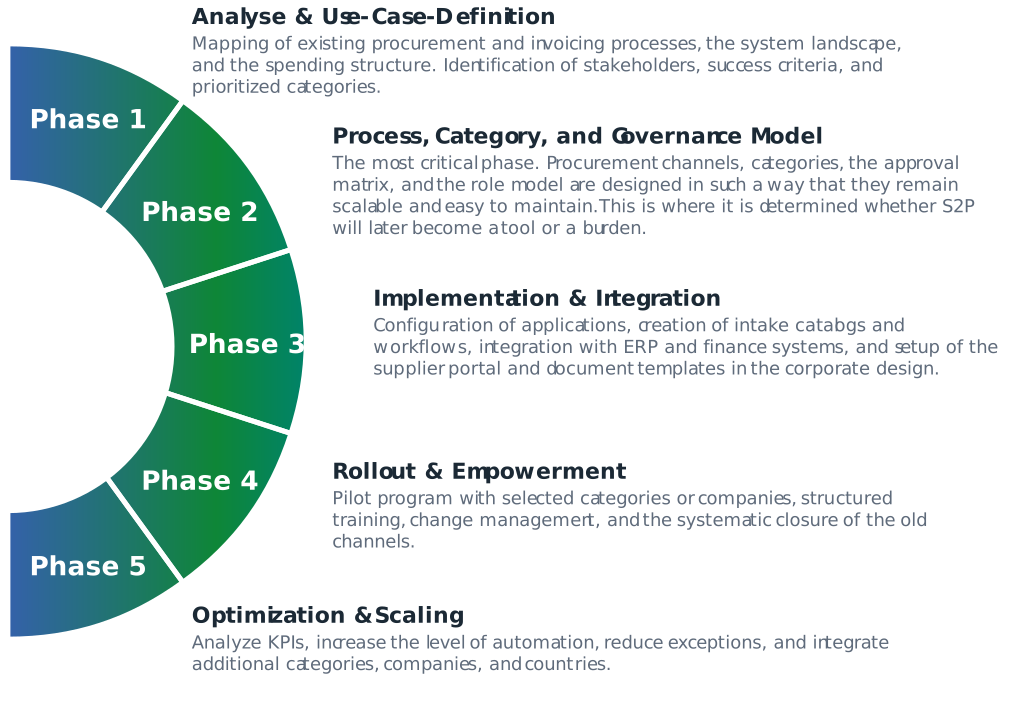
Process model for the s2p implementation
A successful S2P implementation is more than just a software roll-out. It is a reorganisation of the procurement process – with implications for procurement, finance, business units, IT, legal and suppliers. Addressing typical pitfalls at an early stage helps to avoid costly rework.
clear division of roles
ServiceNow S2P in a competitive environment
Differences from traditional procurement suites
Suites such as Coupa or SAP Ariba are primarily transactional procurement platforms with their own supplier network and in-depth sourcing functionality. ServiceNow is stronger in orchestration, the intake experience, case management and integration with other business processes. Many organisations run both in parallel: ServiceNow as the process layer and central point of contact, and the suite or ERP as the execution system.
Where ServiceNow S2P really excels
- A heterogeneous system landscape with multiple ERPs or procurement systems
- A high proportion of indirect procurement and many business units involved
- Existing use of ServiceNow in IT, HR or Finance
- A need for documented governance and evidence of compliance
- Handling exceptions and clarifications as the real time-consuming task
Frequently asked questions about ServiceNow source-to-pay
No. The ERP remains the transactional system for purchase orders, goods receipts, postings and payments. ServiceNow handles the processes leading up to and in between these: intake, sourcing, supplier onboarding, approvals, collaboration and exception handling. Both systems are linked via integrations – with clearly defined data ownership.
These suites are particularly strong in transactional procurement, supplier networks and strategic sourcing. ServiceNow excels in orchestration, intake, case management and integration with other business processes. Which combination is right for you depends on your existing landscape – we’ll clarify this in the Quick Check.
No, but it helps considerably. Existing ServiceNow customers continue to benefit from their existing platform governance, portal experience, integrations and administrative expertise. For new customers, S2P offers a standalone entry point, allowing them to help build the platform’s foundations from the outset.
ServiceNow specifies a timeframe of 12 to 24 weeks for most implementations, depending on the scope and organisational complexity. A focused initial phase – such as intake and approvals for indirect spend within a single company – falls at the lower end of this range. A group-wide roll-out across all modules, countries and ERP instances is a programme with clearly defined phases. We generally recommend a narrow, quickly visible first step.
Catalogues, categories, approval matrices and workflows can be maintained by subject-matter experts using low-code and point-and-click tools without the need for an IT ticket – provided the model was set up correctly during the implementation phase. Any change results in a poorly modelled project. That is why Phase 2 is so crucial.
Via a supplier portal where suppliers can maintain their master data, upload supporting documents, view invoice and payment statuses, and respond to enquiries. This significantly reduces the number of queries to the accounts department and improves data quality, as the data is maintained by the source itself.
Yes. Supplier audits, self-declarations, certificate management with deadline monitoring and risk assessments are all part of the supplier lifecycle. Because all steps are documented in the system, evidence is generated as a by-product of the process rather than as a separate reporting project. The specific implementation depends on the regulatory requirements applicable to you.
ServiceNow has been named a Leader in the inaugural IDC MarketScape for Worldwide SaaS and Cloud-enabled Spend Orchestration (2024) – specifically in relation to its Source-to-Pay Operations solution for procurement, supplier management and accounts payable. ServiceNow is best known for IT, but workflow automation has always been at the heart of the platform.
We’d be happy to advise you
ServiceNow S2P quick check with servistio
In a short meeting, we will analyse your current procurement and invoicing processes, identify opportunities to improve speed, ensure compliance and drive automation, and outline a potential implementation roadmap.

