
ServiceNow
Successfully Implement ServiceNow HR Service Delivery – with servistio
These days, HR is all about the “people experience”—the moments and interactions employees encounter throughout their journey with the company, from their first day in recruitment to their final step as they leave. Our goal is to create a seamless and positive employee experience, just as companies today go to great lengths to deliver outstanding customer experiences. ServiceNow HR Service Delivery supports exactly that by automating many recurring HR interactions and consolidating all HR services on a single, centralized platform—for faster, consistent responses and a noticeable reduction in the workload for HR teams.
Official Partner of
the platform for employee services
What is ServiceNow HR Service Delivery (HRSD)?
ServiceNow is a cloud-based platform that connects workflows and service processes across the entire organization. ServiceNow HR Service Delivery improves the employee service experience by automating many repetitive HR interactions and consolidating all HR services on a single, centralized platform. This boosts the productivity of HR teams while ensuring that employees receive support more quickly, consistently, and reliably. HRSD stands for a modern people experience, comparable to the customer experience—only for employees.
as HR complexity increases
What types of companies is HRSD suitable for?
HR Service Delivery is particularly well-suited for organizations that want to centralize, standardize, and scale their HR services:
Large companies and corporations
Ideal for organizations with complex, multinational structures or a large workforce that require centrally provided HR services.
Small and medium-sized businesses
Ideal for companies looking to move beyond manual processes and adopt standardized, scalable solutions.
Organizations with hybrid or distributed work models
Ideal for companies that need a centralized, digital Employee Service Center to support employees regardless of their location.
Companies with complex HR needs
Particularly well-suited for frequent onboarding and offboarding, high volumes of requests, and demanding compliance and policy processes.
for scalable HR services
where HRSD is most effective
HRSD is particularly useful when
- When customer inquiries come in through multiple channels and need to be consolidated
- When business units are regularly involved in processing
- When there is currently a lack of transparency regarding status, responsibilities, and SLAs
When alternative solutions may be sufficient
- For very small companies with simple HR processes, leaner tools may be sufficient.
more than just an HR tool
Key Features of ServiceNow HRSD
Short answer: HR inquiries are centrally recorded, tracked, and efficiently resolved using knowledge.
Standardized HR processes are automated, allowing employees to submit requests and track their status. At the same time, HR teams gain a clear overview, enabling them to handle cases in a structured manner and leverage knowledge to resolve issues more quickly. The HR knowledge base is made centrally available, reducing repetitive inquiries.
Short answer: HR documents are managed securely, efficiently, and in compliance with regulations.
EDM enables the management of large volumes of documents through cloud-based storage, a clear structure, easy retrieval, and secure access rights. This allows employees to seamlessly fill out, submit, and receive documents related to benefits, payroll, or other services.
Quick answer: HR agents get a centralized workspace for fast and consistent support.
In the Agent Workspace, HR staff can interact directly with employees, answer inquiries, and resolve cases efficiently—with all relevant information and tools in one place.
Quick answer: Employees can find answers, submit requests, and track their status in one place.
Through the Employee Center, employees have a single point of access to HR services, knowledge, and support.
Quick answer: Onboarding, transitions, and exit processes are supported through automation.
Standardized journeys ensure consistent experiences throughout the employee lifecycle.
Short answer: HR services are becoming measurable and can be optimized in a targeted manner.
Dashboards and KPIs enable data-driven improvements rather than relying on gut feelings.
Short answer: HRSD complements existing HR systems as an experience and service layer.
Workday, SuccessFactors, or SAP remain the system of record—HRSD orchestrates the services on top of them.
From our experts
News from the ServiceNow HRSD World
Working Together for Better HR Services
Why Servistio is the right partner for HRSD
In-depth understanding of HR processes and enterprise-level expertise
servistio combines HR expertise with extensive ServiceNow experience across the entire employee lifecycle.
Experience with HR systems and integrations
Years of hands-on experience with SuccessFactors, SAP HCM, and other HR platforms ensures seamless integration.
Boutique approach with personalized collaboration
Dedicated contacts, short communication channels, and standards as a foundation—always implemented in a way that fits the organization.
Advanced Document Builder as a complement
With the Advanced Document Builder (ADB), servistio enables efficient document creation and CI-compliant templates directly in ServiceNow.
From Vision to Scaling
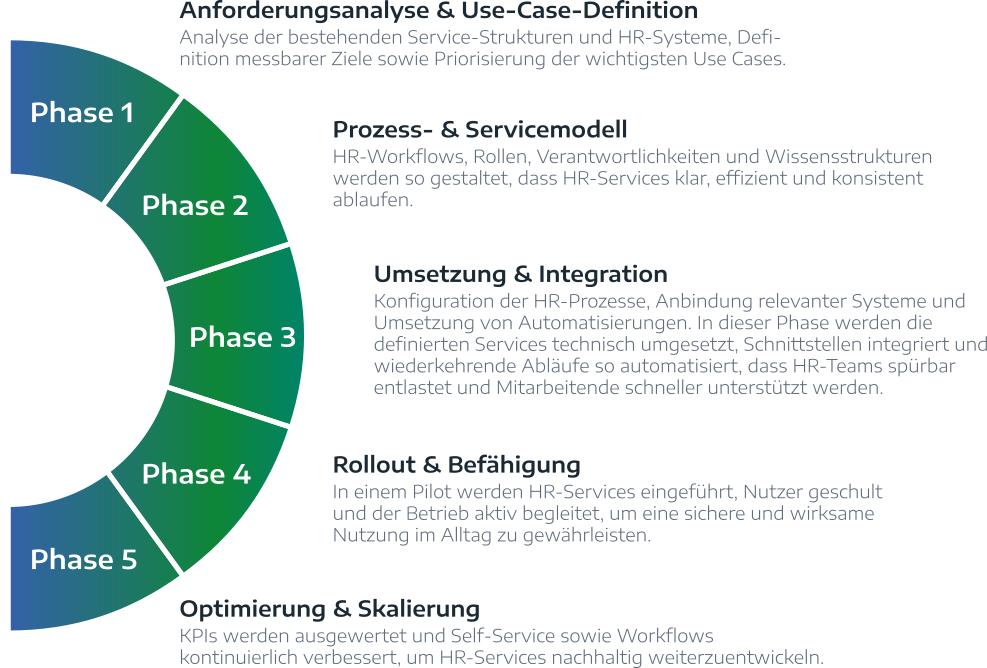
Process model for HRSD implementation
A successful HRSD implementation requires careful planning, a well-thought-out adaptation to the organization, and continuous optimization after go-live. By addressing typical pitfalls early on, you can reduce risks and ensure a smooth, effective implementation.
clarity for the entry
Frequently Asked Questions About HRSD
No. ServiceNow HRSD does not replace an HCM system; rather, it complements it as an “Employee Experience Layer.” The core system remains the system of record, while HRSD serves as a central hub through which employees can access all HR services in a unified manner and conveniently submit requests.
ServiceNow HRSD offers numerous preconfigured integrations to seamlessly connect existing HR and learning systems. These include learning integration points such as Cornerstone, Pluralsight, Workday Learning, Udemy, and SuccessFactors Learning, as well as Workday, Oracle, and SuccessFactors integration points for HCM, recruiting (ATS), skills, goals, and feedback. Platform integrations such as Credly and many other out-of-the-box (OOB) connectors are also available.
HRSD reduces manual, repetitive tasks through automation, virtual agents, and knowledge management. Recurring issues can be resolved more quickly or answered directly through self-service, while HR teams are relieved of some of their workload and can focus on more complex issues.
No. HRSD is an end-to-end solution that supports the entire employee lifecycle. The Employee Center serves as a central one-stop shop for employees, offering not only case and knowledge management but also enterprise onboarding and transitions, document management, and other journey-based services.
Yes. The Employee Center Portal not only supports HR, but can also integrate IT, workplace, finance, and legal services. This means employees no longer have to switch between different systems; instead, they can access all internal services in one central location.
We’d be happy to assist you
hrsd-quickcheck with servistio
In a compact meeting, we analyse the maturity level, potential and a possible implementation roadmap.