
No second portal. No long learning curve. Just three lines of code.
About the ServiceNow Engagement Messenger and why hardly anyone knows about it, even though it’s one of the platform’s smartest features.
The portal is here. It has been built up over many years, designed to reflect the brand, and is deeply embedded in the company’s corporate identity. Customers are used to it. The team is familiar with it. Then ServiceNow comes along and brings its own portal with it. The question arises: should we build everything from scratch? Run two systems in parallel? Get customers used to a new system? Both approaches cost time, money and nerves. But there is a third way.
A brief overview of ServiceNow as a connecting layer
Before we get to the Messenger, let’s take a step back: in practice, ServiceNow acts as a connecting layer between data silos. CRM, ERP, ticketing systems, communication channels – ServiceNow brings these worlds together and turns them into a consistent, manageable customer experience. That is the true value of the platform, which holds everything else together. The Engagement Messenger is the channel through which customers interact with precisely this world, without even realising it.
What is Engagement Messenger?
The Engagement Messenger doesn’t require a new portal or a new interface that customers first have to get to grips with. It’s a small widget that can be embedded into any existing website and works seamlessly there. The customer sees a chat icon, just like the ones they’re used to seeing on dozens of websites. They click and get help. The fact that ServiceNow is running in the background is irrelevant to them. For the company, however, it is anything but irrelevant, because it means: no training for customers. No marketing for a new portal. No friction during the transition.
You are currently viewing a placeholder content from YouTube. To access the actual content, click the button below. Please note that doing so will share data with third-party providers.
More InformationThe specific scenario: an energy supplier, a portal, a decision
Green Grid is an energy company with a well-established customer portal. Products, bills, contract details – it’s all there. The portal is brand-aligned, functional and well-established. And so the question arose: should the whole thing be overhauled just so that customers can submit service requests? The answer was: no. Instead, the Engagement Messenger was integrated.
This allows Green Grid customers to book an appointment, select a location, choose a time slot, specify their query and start a chat. Initially with a virtual agent that handles frequently asked questions. If necessary, there is a seamless transition to a real service representative who can see straight away what has been discussed so far and doesn’t have to start from scratch.
All of this takes place within the look and feel of the existing portal. The customer never leaves their familiar interface.
Technical integration of the Engagement Messenger
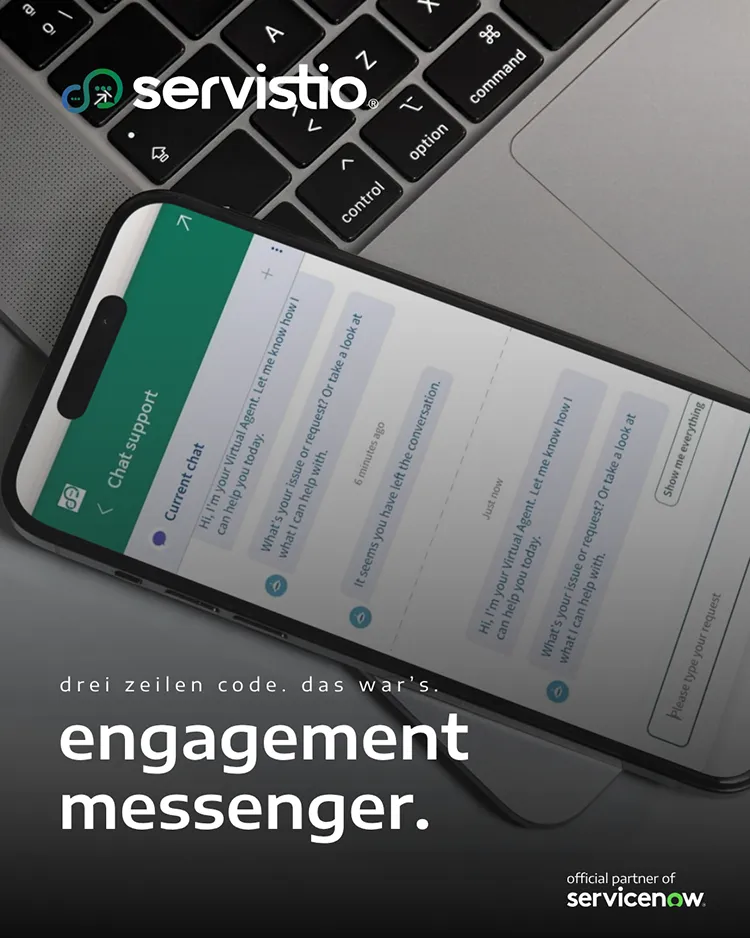
Here’s the surprising part: the technical integration of the Engagement Messenger essentially consists of just three lines of code. A small widget is embedded into the website – that’s it. No dependency on the portal technology used. No complex interface development. No months-long integration project.
Once integrated, intelligent routing, AI-powered responses and handover to live agents with a complete conversation history all run in the background. These are ServiceNow functionalities that are already in place. The Messenger makes them accessible to customers without the need to build a new infrastructure.
What this means in practice — for academic departments and IT
For Customer Service and Operations: Customers go where they already are. The barrier to making contact is lowered. The transition from self-service to a live agent is seamless. And the agent has the context from the outset – no need for “Could you explain that to me again?”
For IT: No dependency on the existing portal framework. No complex migration. The existing ServiceNow instance is extended by a channel, not a system.
Who is this particularly relevant for?
Companies with complex, established customer portals – for example, in the telecommunications, energy, insurance and housing sectors – regularly face precisely this question: How do I integrate modern service management without having to rebuild everything from scratch? Engagement Messenger is a solution to this problem that is often underestimated in practice. It’s so simple that people find it hard to believe.
Would you like to see how this would work in your environment? We’d be happy to demonstrate it to you live! We look forward to discussing this with you.