
ServiceNow (SOM)
Successfully implement ServiceNow Sales and Order Management (SOM) – with Servistio
ServiceNow Sales and Order Management (SOM) manages the entire lead-to-cash process on a single platform: product catalogue, quotation, order entry, order breakdown and fulfilment.
In many companies, the sales process ends with the signature – and that is where the real problem begins. The order is passed on via email, Excel or an interface to fulfilment, technical support and service. There, it is reinterpreted, broken down into sub-orders and tracked manually. There is a growing discrepancy between what the customer has ordered and what is actually delivered.
servistio helps you implement SOM in such a way that an order remains within a single process from entry right through to activation – with a catalogue that ensures sales and technical departments speak the same language.



Official Partner of

From quotation to activation
What is ServiceNow Sales and Order Management (SOM)?
Sales and Order Management is ServiceNow’s suite of applications for sales and order processing. It forms part of ServiceNow’s CRM product family and is built on the Customer Service Management (CSM) platform. SOM combines the product catalogue, pricing logic, quotation creation, order entry and fulfilment within a single model – making it less of a sales tool and more of an operating system for orders.
Control rather than interface chaos
Why som is relevant for managers
Short answer: Not in sales and not in technical services – but at the handover between the two.
The disconnect between sales and delivery is rarely a systemic problem, but rather a modelling problem. Sales sells a commercial package, whilst engineering delivers individual services, and nobody has defined how one translates into the other. The result: queries, duplicate entries, rework on orders and deadlines that have to be corrected retrospectively.
SOM makes this translation a standard procedure in the catalogue rather than an ad hoc arrangement between teams. What a sold product entails from a technical perspective is documented and applied consistently to every order.
Short answer: Orders are automatically broken down, processed in parallel and only paused where a decision is required.
Instead of a chain of manual hand-overs, a workflow is created: which sub-tasks depend on one another, which run in parallel, and which require a technician to be deployed. Tasks are sent directly to the relevant teams and systems. Delays become apparent whilst they can still be rectified – not only once the customer has called.
Short answer: Every order can be tracked right down to the sub-order level, including age, blockers and due date.
Order volumes, lead times, reasons for cancellation and outstanding stock are all contained within a single data model. This makes it possible to answer questions that would otherwise take a great deal of effort to compile: Which products cause the most rework? At which stage do orders get held up? How much of the revenue already generated has not yet been activated? Managers make decisions based on real process data rather than status reports.
Short answer: New offers are created in the catalogue, not in the project.
Products, bundles, options and pricing models are modelled centrally. If the catalogue structure is set up properly, new variants can be configured without having to rebuild the fulfilment process from scratch each time. This significantly reduces the time between the product decision and the launch.
a task, a process
how an order is processed by SOM
From the approved quotation to the active service, the order remains a single, continuous data record. The process is described in five steps.
Step 1 – Quotation
The quotation is configured, priced and approved via CPQ. This is based on the central product catalogue.
Step 2 – Order entry
The approved quotation is converted into an order containing full details of the customer, product and delivery date.
Step 3 – Breakdown
The order is broken down into sub-orders in accordance with the catalogue rules – from the service sold right down to the resources required.
Step 4 – Orchestration
A workflow plan governs the sequence, dependencies and responsibilities. Systems, the back office and the field staff carry out their tasks.
Step 5 – Activation and Operation
The service is active and the inventory has been documented. Any subsequent changes will be processed as new orders against the same inventory.
Structure for the assignment
Key components of SOM
Short answer: A model of what is being sold and of what needs to happen technically to make that happen.
The catalogue separates the commercial offering from the services and resources behind it – and links the two via rules. This forms the basis for an order to be broken down automatically. Catalogue modelling is the part of a SOM project that has the greatest impact on subsequent operations.
Short answer: List prices, tiered pricing, subscriptions and usage-based models are managed centrally and apply across all channels.
Pricing rules are maintained once and applied everywhere: in direct sales, via the partner channel and in self-service. This eliminates the most common source of error in decentralised sales organisations – differing price levels across channels.
Short answer: Guided configuration, rule-based pricing and binding quotations as part of SOM.
CPQ is the quotation module of the suite. Configuration rules rule out impossible combinations before they appear in the quotation. Find out more on the CPQ page.
Short answer: Orders are created in the same format, regardless of the channel.
Whether the order is initiated by the internal sales team, via a partner or via the customer portal, the structure, mandatory fields and validation checks are identical. Any missing information is flagged during entry, not during fulfilment.
Short answer: The commercial order is broken down into product, service and resource orders according to predefined rules.
This breakdown follows the rules defined in the catalogue and generates an order hierarchy. Each level has a clear purpose: what has been sold, what service this entails, and what resources are required for it. Downstream teams are thus given specific tasks rather than an order description that they have to interpret themselves.
Short answer: A workflow manages all sub-tasks – including dependencies, deadlines and visible progress.
The orchestration system allocates tasks to systems, internal teams and field staff, whilst ensuring dependencies are maintained. The progress of a job can be tracked visually. For on-site assignments, SOM utilises Field Service Management (FSM) rather than setting up a second planning process.
Short answer: Relocations, upgrades, additional bookings and cancellations are processed as standard change orders, not as special cases.
The majority of the order volume arises after the initial sale. SOM treats changes to the existing portfolio as a separate order type with its own breakdown. This ensures that it remains clear which service a customer had at what point in time – a prerequisite for accurate billing.
Short answer: Any issues arising during the course of an order are dealt with where the order is located.
If an order gets stuck, a case is created that is directly linked to the sub-order in question. The service team can view the order status without having to switch to another system, and the customer receives a definitive answer rather than being asked to follow up.
for complex services
Who is som particularly suitable for?
More than just implementation
Why Servistio is the right partner for SOM
25 years’ experience in telecommunications
Order management involving catalogue breakdown and network resources originated in the telecommunications sector. This is precisely where servistio’s core expertise lies: over 25 years of telco expertise gained from our own business environment – and thus process knowledge that cannot be acquired through a single project.
The catalogue is key, not the tool
Most SOM projects fail not because of the technology, but because of a catalogue model that conflates commercial and technical perspectives. servistio defines this model prior to configuration – with sales, technical and billing teams all sitting around the same table.
Integration with CPQ, CSM and FSM
SOM realises its full value through collaboration: quotations in CPQ, customer enquiries in
CSM
, and field assignments in FSM. servistio understands these interrelationships from hands-on experience and approaches the project from the outset with a view that transcends module boundaries.
A boutique approach – personal collaboration on an equal footing
Dedicated contacts, short lines of communication, and the consultants who take part in the workshops are also the ones who implement the project. As a ServiceNow Premier Partner with over 50 certifications within the team, servistio brings the in-depth platform expertise required for complex order processes.
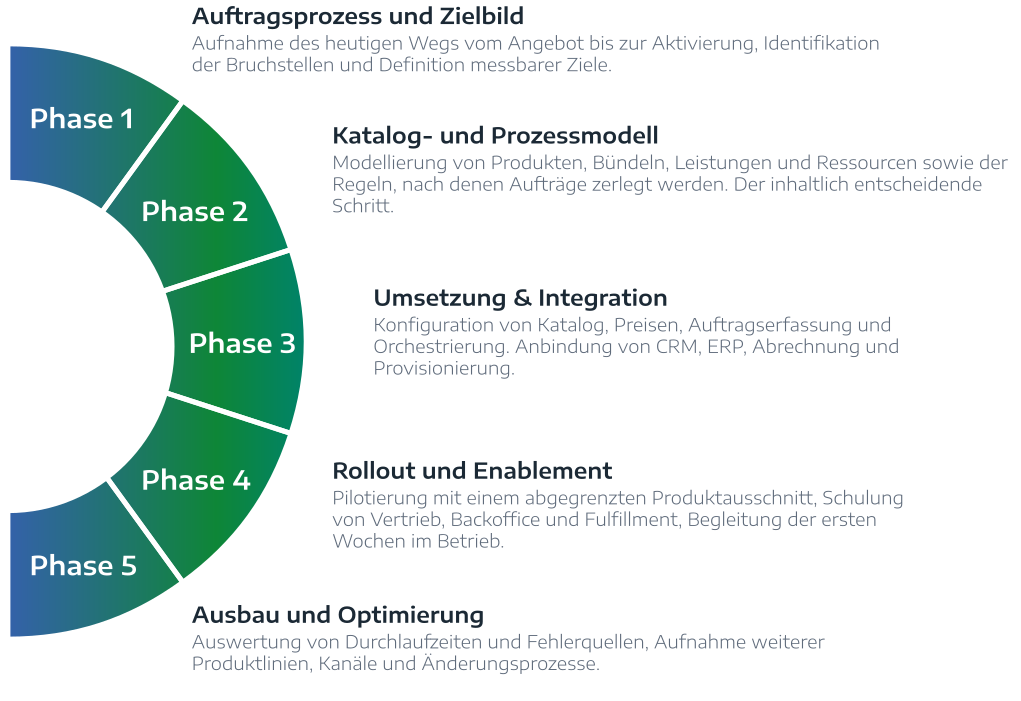
Methodological approach to the end-to-end order
Process model for the introduction of SOM
Clarity for getting started
Frequently asked questions about ServiceNow SOM
No. The CRM system remains responsible for leads, contacts and opportunities, whilst the ERP system handles financial data and stock levels. SOM manages the order from entry right through to fulfilment and is linked to both systems via interfaces. The key is to define which system holds which information.
CPQ is part of the suite and covers quotation creation. Where quotations are already being created in another system, SOM can also be integrated into that process. As a rule, the shared catalogue is the reason for considering the two together.
Yes, and that is the recommended approach. Starting with a clearly defined product range provides a robust reference process, which can then be extended to other products and channels.
If the modelling is done properly, specialist administrators can maintain new products, bundles and prices without any development effort. If the modelling is poorly done, every product change becomes a project – which is why the focus of an implementation is on the modelling phase.
Once a bundle has been sold, it is automatically broken down into its constituent parts: the products it contains, the resulting services and the resources required to fulfil the order. Each constituent part becomes a traceable task in the fulfilment process.
No. It has its origins in the telecommunications sector, and there is an extended version of it for that industry. It proves useful wherever a sold contract needs to be broken down into several services and parties involved.
SOM runs on the ServiceNow AI Platform. AI-powered features assist with order entry, status enquiries and the identification of stalled orders. The scope of functionality continues to evolve with each release and is assessed on a per-implementation basis.
Sign up
som-quickcheck with servistio
In a short session, we’ll look at your journey from quotation to activation, identify the sticking points and outline a realistic starting point.

