From the Core Business Suite to the ESM Foundation:
What has changed, and why is this important?
First of all: What is the Core Business Suite?
If you’ve been part of the ServiceNow ecosystem for a while, you’re probably familiar with the Core Business Suite (CBS). Think of the CBS as ServiceNow’s answer to the question: “What if HR, Finance, Legal, Procurement, and Facility Management all worked together on the same platform?”
The CBS brought together core functionalities for the following departments into a single system: HR case management, legal request tracking, procurement workflows, financial processes, and workplace services. Instead of each team operating its own isolated ticketing system (or even managing requests via email), CBS provided them with a shared infrastructure, shared data, and a consistent user experience for employees seeking assistance.
This was a significant step forward. However, IT was not involved in the process—and for most companies, IT remains the nerve center of internal service delivery.
This is precisely where Enterprise Service Management (ESM) is becoming increasingly important.
What does Enterprise Service Management offer?
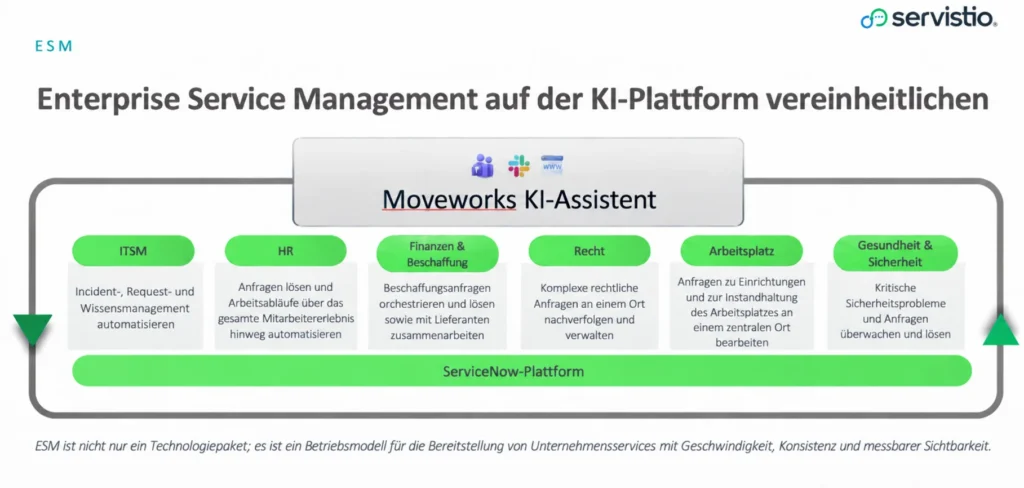
Enterprise Service Management (ESM) Foundation is ServiceNow’s latest offering, launched in April 2026. Simply put, it combines all the features of CBS and integrates ITSM (IT Service Management) into the same bundle. This creates a truly unified service platform that covers all key departments within an organization.
The target audience consists of midsize companies with up to about 5,000 employees that have outgrown simple tools such as Jira Service Management but are neither ready for nor in need of the complexity of a Fortune 500-level implementation. ESM specifically bridges this gap.
Essentially, it’s one platform, one data model, and one employee experience—for IT, HR, finance, legal, procurement, the workplace, and health and safety.
ESM isn’t simply about bringing more departments onto the same platform. It’s about creating a more connected way for employees to request help, for teams to collaborate, and for companies to deliver services faster and more consistently.
Why This Is Actually Important
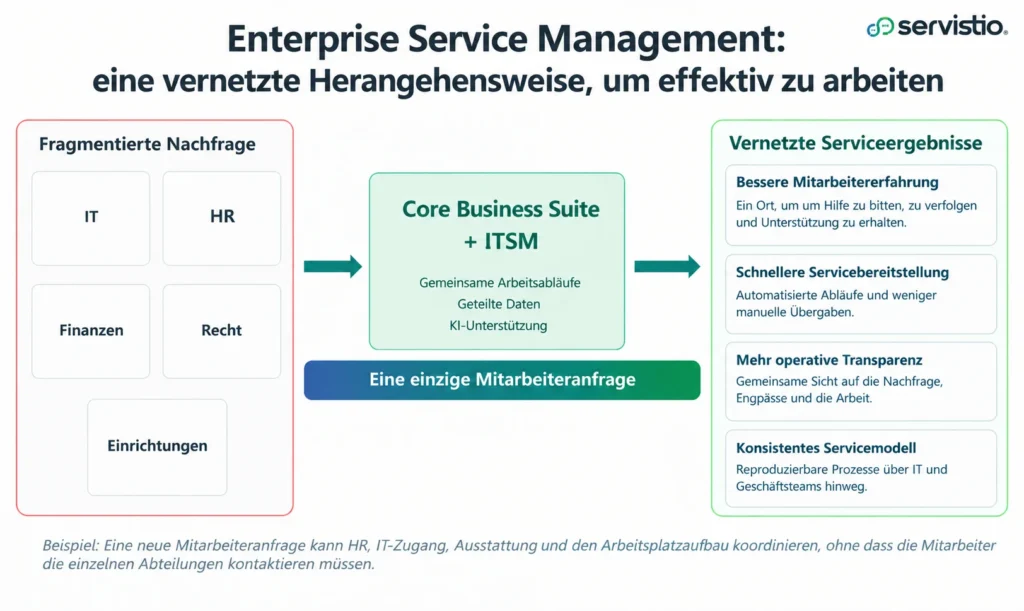
Imagine a new employee’s first week on the job. She needs a preconfigured laptop, access to her pay stubs, a parking permit, and a copy of the company’s legal confidentiality agreement. In most medium-sized companies today, that means four different systems, four different portals, and a flood of emails with the reply, “Sorry, wrong team.”
With ESM, she only needs to access a single platform and submit a request. The platform automatically forwards each task to the right department, tracks approvals, and provides an overview of all processes. The IT team sees the ticket, HR sees theirs, and the legal department is notified, since everything is based on a shared data model.
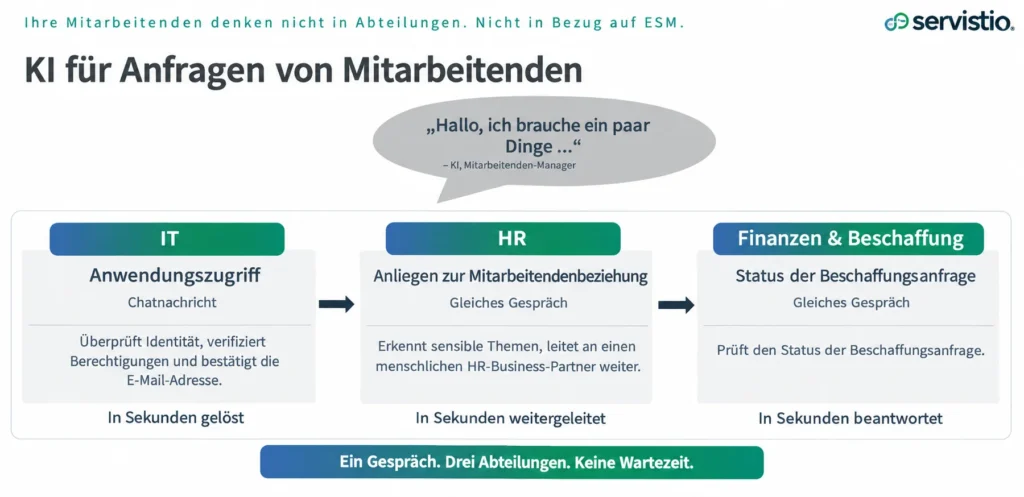
And when a routine request like “How many vacation days do I have left?” comes in, it’s processed directly by AI without any employee intervention.
With ESM, the same process can be managed across teams via a single request and a connected workflow. The employee doesn’t need to know which department handles which part of the process. The company can coordinate the work behind the scenes, track progress, reduce hand-offs, and create a more seamless user experience.
What’s changing with the new license?
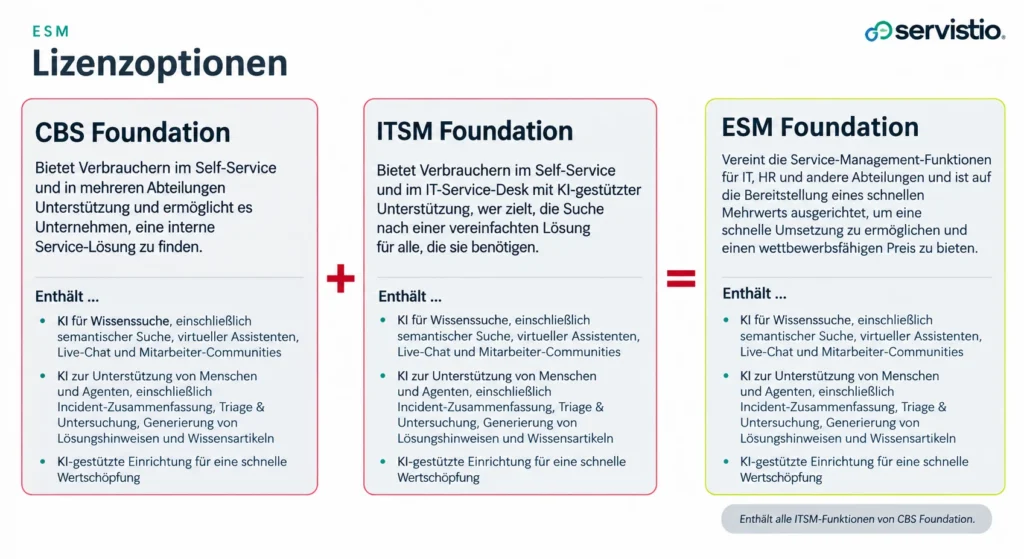
The new “Enterprise Service Management Foundation” license combines essential ITSM features and Core Business Suite capabilities into a more unified package, with AI already integrated into the concept. These are important innovations because they facilitate the development of a cross-departmental, interconnected service model.
By merging “ITSM Foundation” and “CBS Foundation” into a single “User” quota, you purchase licenses for all employees in your organization rather than separate licenses for each department.
Instead of requiring companies to deploy separate solutions for each individual department, the license provides a starting point for delivering shared services, standardized workflows, employee self-service, AI-powered support, and cross-departmental coordination. The product documentation also highlights a wide range of built-in features, including pre-built service elements and tools designed to help companies get started quickly.
More important than the number of features, however, is the operating model that supports these features: a single platform, shared data, consistent user experiences, and the ability to scale incrementally.
This offers several key benefits:
A better employee experience. Employees can request assistance through a more consistent, intuitive interface instead of having to navigate through individual departments.
Faster and more reliable service delivery. Standardized workflows reduce manual steps, improve assignment, and facilitate the correct handling of requests.
Greater efficiency for service teams. Repetitive tasks can be automated, knowledge can be reused, and teams can focus more on complex work that requires human judgment.
Improved transparency and control. Managers gain a clearer overview of demand, bottlenecks, service levels, and performance across all departments, rather than just within individual departments.
Faster time-to-value. One of the most important practical benefits of the new approach is the ability to implement core functionality within weeks rather than months. This is crucial because transformation initiatives often lose momentum when it takes too long to see added value. A faster implementation model enables companies to start with meaningful use cases, demonstrate results early on, and expand from there with minimal disruption.
The “No Dead End” Architecture
One of the more underappreciated aspects of ESM Foundation is how it responds to a company’s growth as it outgrows the solution’s capabilities. Unlike some entry-level products that require a cumbersome migration to unlock advanced features, ESM Foundation runs on the exact same platform, code base, and data model as the higher tiers of ServiceNow.
The transition from Foundation to ITSM Advanced or CBS Prime is a license change, not a technical migration. Data is preserved. Configurations are carried over. Teams do not need to be retrained on a new system. This makes ESM a true starting point rather than a stepping stone that will eventually need to be replaced.
Is ESM Foundation the Right Choice for Your Company?
ESM Foundation is worth serious consideration if your company manages service delivery across departments using separate tools, if your IT team is drowning in tickets that could be routed elsewhere, or if senior management has asked for AI but your data is too siloed to respond.
The platform was specifically designed to reduce this complexity, and results from early adopters suggest that it is delivering on that promise.
Conclusion
Enterprise Service Management reflects a comprehensive shift in the way companies view internal services. Employees expect the same level of simplicity and responsiveness in the workplace that they are accustomed to from consumer services. At the same time, companies need greater efficiency, better transparency, and stronger cross-departmental coordination.
By combining service management principles, cross-departmental workflows, AI, and faster implementation, ESM offers a practical path to a more connected enterprise. The Core Business Suite plays a key role in this journey by extending structured service delivery beyond IT and helping business functions operate more consistently and agilely.
The result is not just better technology. It is improved collaboration within the organization.
Do you have questions about the ESM Foundation or how it fits into your company’s ServiceNow roadmap?
Would you like to learn more about the possibilities of ESM? Then get in touch with us: